
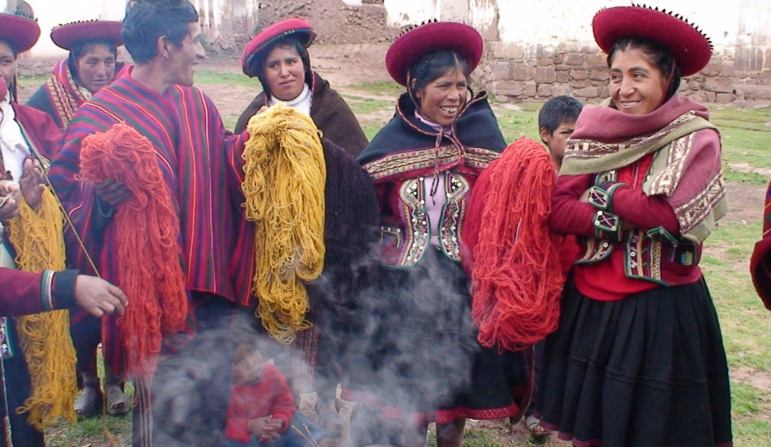
The first time I climbed the narrow dirt road into the high Andes, the air changed. It thinned, cooled, and sharpened, almost as if the mountains themselves were taking a long, quiet breath. At 12,000 feet, the world feels both vast and intimate. You hear everything: the soft shuffle of sandals across stone, the laughter of children, the hush of wind slipping across the ridgelines. And then, as you step into the village, you see the colors – deep reds, sun‑worn golds, vivid blues – woven into blankets, shawls, bags, and other items that carry on the skills of generations past.
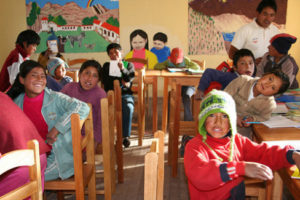
Learning time in the village classroom.
This was the moment my life in Peru changed. Not because of anything dramatic or grand, but because of a tug in my chest. It was a knowing, an unmistakable sense that this place was asking something of me.
I didn’t go looking for this community. A friend introduced me to it after years of us trading discoveries across the Sacred Valley in the form of ruins, routes, artisans, and stories. But when I arrived in this village, the farthest from the main road, tucked away where tourist buses rarely bother to go, I knew immediately that it was different. There was no performance here, no rehearsed welcome for passing travelers. There was simply an honest, hardworking life. The women wove. The men tended the fields. The children, so bright, curious, and full of potential, spoke primarily their ancestral language. And yet their schooling was in Spanish.
We teach Spanish, reading, writing, arithmetic, arts and crafts, music, creative projects, playtime, personal hygiene, and we offer extra help with schoolwork — and through all of this, confidence and possibility begin to grow. The community teaches us humility, patience, humor, and what it means to hold one another up. That is reciprocity — AYNI — a covenant of mutual care.

A guest visiting the classroom and sharing time with students.
Over the years, I’ve watched so many of these children grow — first with wide eyes and shy smiles and later standing proudly in crisp high‑school uniforms. Last year, one became a police officer, something that would have been nearly impossible without the foundation he built in that little classroom on the mountainside. Some return to help teach the younger children, passing forward what was once offered to them. To me, that is the truest measure of success — not numbers or metrics, but continuity, connection, and one generation woven into the next.
People often ask me why I include this village on every itinerary I create. Why bring travelers here? Why make this remote, rugged, breathtaking place a constant, no matter what else their journey holds? The answer is simple: because this community is the heart behind everything I do. 20 years ago I realized that I had zero interest in group tours — the babysitting, the emotional triage, the absence of genuine connection — I asked myself what I truly wanted my work in Peru to be. The answer came quickly: I wanted people to experience Peru the way you would if you came to visit your closest friends — to feel the warmth of being welcomed instead of handled, and to see the country not through checklists, but through the eyes of those who call it home.
And if Peru is, as I often say, every country in the world in one — with its Andes, its Amazon, its deserts, its Pacific coast, its ancient cultures, and its endless microclimates — then this village is its soul. It reminds us that travel is not only about seeing, but about being seen; not only about learning, but exchanging; not only about taking in beauty, but honoring the people who hold it. Once again: AYNI — reciprocity.
Every traveler travels to Peru with us spends an afternoon here — not as a spectator but as a guest. They sit beside the weavers and the looms shaped by centuries of whispered tradition as they click softly beneath their fingers. They listen to the community’s history. They spend time with the children — some still small, some now grown — and connect with them as they move easily between their mother tongue and Spanish, between tradition and opportunity. In these moments of genuine connection, something shifts in the visitors. You can see it in their smiles, in the way they linger a little longer before leaving, and in the way they speak about Peru afterward with a new softness. They begin to understand that meaningful travel doesn’t just change the traveler — it changes the places we touch.
And that is why this village is on every itinerary. Because at 12,000 feet, surrounded by mountains older than memory, you can feel what reciprocity truly means right down to your bones. And once you feel it — once you feel AYNI in its purest form — PERU NEVER LEAVES YOU.


